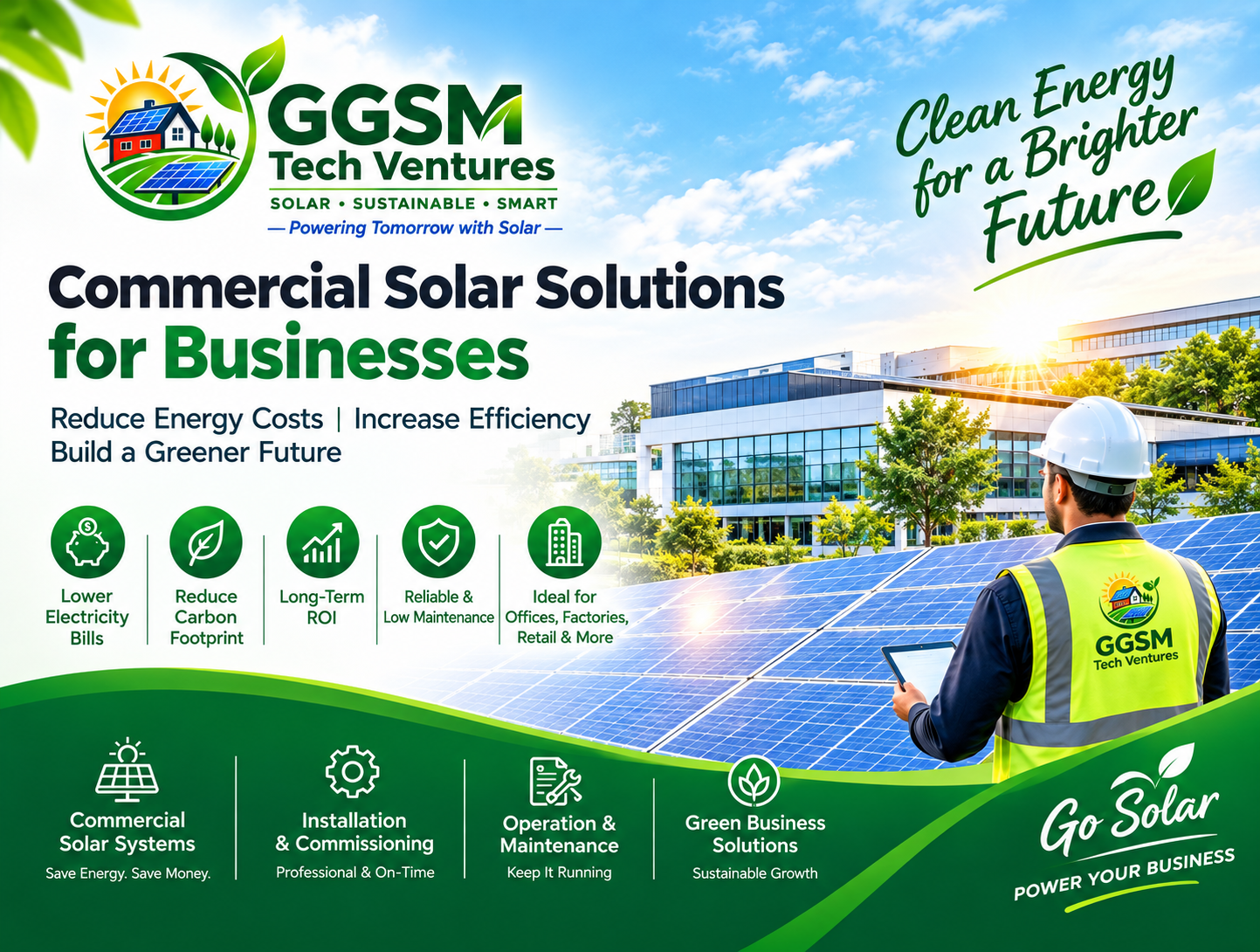
Commercial Solar Solutions for Businesses
Businesses today are looking for smarter ways to reduce operating costs, improve energy efficiency, and adopt sustainable practices. Commercial solar solutions provide an effective way for businesses to generate clean electricity while reducing their dependence on conventional power sources.
From offices and retail stores to factories, warehouses, schools, hospitals, and other commercial buildings, solar power can be customized according to the electricity requirements and available rooftop or land area.
What Are Commercial Solar Solutions?
Commercial solar solutions are solar power systems designed specifically for businesses and commercial properties. These systems use solar panels to convert sunlight into electricity that can be used to operate lighting, computers, machinery, air conditioning, pumps, and other electrical equipment.
A commercial solar plant can be designed according to factors such as:
Monthly electricity consumption
Available rooftop or installation area
Connected electrical load
Business operating hours
Solar generation requirements
Budget and project objectives
Why Should Businesses Choose Solar Energy?
Electricity is one of the major operating expenses for many businesses. Installing a solar power system can help businesses manage their energy costs while making better use of renewable energy.
1. Reduce Electricity Costs
Solar panels generate electricity from sunlight, allowing businesses to produce a portion of their own power. This can help reduce electricity purchased from the grid and potentially lower monthly electricity expenses.
2. Generate Clean Energy
Solar energy is renewable and produces electricity without directly burning fossil fuels during operation. Businesses can use solar power as part of their efforts toward cleaner energy consumption.
3. Improve Energy Independence
Generating electricity on-site can reduce dependence on grid electricity. A properly designed solar system can provide businesses with an additional source of power during suitable sunlight hours.
4. Make Better Use of Rooftop Space
Large commercial rooftops, warehouses, factories, schools, and offices often have unused space. These areas can potentially be used for installing solar panels.
5. Support Sustainable Business Goals
Businesses increasingly focus on energy efficiency and environmental responsibility. Solar power can contribute to a company’s sustainability initiatives while supporting long-term energy planning.
Commercial Solar Systems for Different Businesses
Commercial solar systems can be customized for different types of properties and energy requirements.
Offices
Solar systems can help power computers, lighting, air conditioning, networking equipment, and other office appliances.
Shops & Retail Stores
Retail businesses can use solar energy for lighting, cooling systems, display equipment, billing systems, and other electrical requirements.
Factories & Manufacturing Units
Manufacturing facilities often have significant electricity consumption. A properly designed solar plant can help offset a portion of their daytime energy requirements.
Warehouses
Warehouses with large rooftops can be suitable locations for rooftop solar installations, subject to structural and site feasibility.
Schools & Educational Institutions
Schools and educational institutions can use solar energy for classrooms, lighting, fans, computers, water pumps, and other facilities.
Hospitals & Healthcare Facilities
Hospitals require reliable electricity for lighting, medical equipment, cooling, and other essential systems. Solar can be incorporated into their broader energy strategy after evaluating their specific requirements.
Types of Commercial Solar Systems
On-Grid Solar System
An on-grid solar system is connected to the electricity grid. Solar electricity is primarily used by the business, while grid electricity can supplement demand when solar generation is insufficient, subject to the applicable electricity regulations and metering arrangement.
Off-Grid Solar System
An off-grid solar system operates independently from the electricity grid and generally requires battery storage. It can be considered for locations where grid connectivity is unavailable or where independent power supply is required.
Hybrid Solar System
A hybrid system combines solar generation with battery storage and grid connectivity. It can provide greater flexibility for businesses that require energy storage along with solar generation.
How GGSM Tech Ventures Can Help
At GGSM Tech Ventures, commercial solar projects can be planned according to the specific requirements of each business.
Our approach can include:
Site assessment
Electricity consumption analysis
Solar plant design
Solar component selection
Procurement support
Professional installation
Electrical setup
Testing and commissioning
Solar monitoring
Maintenance support
Our goal is to provide a complete solar solution from planning and design to installation and commissioning.
Quality Solar Components
The performance of a commercial solar plant depends on the quality of its major components and the quality of installation.
GGSM Tech Ventures focuses on selecting suitable solar components based on project requirements. Tata solar modules with Bifacial TOPCon technology can be considered for suitable projects, depending on system design, availability, and customer requirements.
Professional Installation & Commissioning
A commercial solar plant requires proper installation, electrical connections, safety arrangements, testing, and commissioning.
Professional installation helps ensure that the solar modules, mounting structures, cables, inverters, protection equipment, and other components are properly integrated into the system.
Solar Monitoring for Businesses
Solar monitoring allows businesses to track the performance of their solar plant. Depending on the system and monitoring platform, users may be able to view information such as:
Solar power generation
Daily energy production
Monthly generation
System performance
Inverter status
Performance alerts
Monitoring can help businesses understand how their solar system is performing and identify potential issues.
Is Commercial Solar Suitable for Your Business?
The suitability of a commercial solar system depends on several factors, including electricity consumption, roof or land availability, structural conditions, sunlight availability, electrical requirements, applicable regulations, and project budget.
A professional site assessment can help determine the appropriate system size and configuration.
Conclusion
Commercial solar solutions can help businesses explore renewable energy, improve energy efficiency, and manage their electricity requirements more strategically. Whether you operate an office, shop, factory, warehouse, school, hospital, or other commercial facility, a customized solar system can be designed according to your specific requirements.
GGSM Tech Ventures provides end-to-end solar solutions including planning, design, procurement, installation, commissioning, monitoring, and maintenance support.
If you are planning a solar project for your business, get in touch with GGSM Tech Ventures for a customized commercial solar solution.
Frequently Asked Questions
1. What is a commercial solar system?
A commercial solar system is a solar power plant designed to meet the electricity requirements of businesses and commercial properties.
2. Can solar panels reduce business electricity costs?
Solar generation can reduce the amount of electricity a business needs to purchase from the grid, depending on system size, consumption pattern, tariffs, and applicable regulations.
3. Can solar be installed on a factory or warehouse?
Yes. Factories and warehouses can be suitable for solar installations, particularly when sufficient rooftop or land area is available. A site and structural assessment should be completed before installation.
4. Which solar system is suitable for a business?
The suitable system depends on the business’s electricity consumption, operating hours, site conditions, grid availability, energy-storage requirements, and project objectives.
5. How much solar capacity does my business need?
The required capacity depends on electricity consumption, available installation area, solar generation potential, and the desired level of energy offset. A professional assessment can help determine the appropriate capacity.
6. What are Bifacial TOPCon solar panels?
Bifacial solar panels can generate electricity from light received on both sides of the module, while TOPCon is a solar cell technology designed to improve module efficiency and performance characteristics.
7. Does GGSM Tech Ventures provide solar installation?
Yes, GGSM Tech Ventures provides solar project support including system planning, procurement, installation, electrical setup, commissioning, and maintenance support.
8. Can businesses monitor their solar plant?
Yes. Compatible solar monitoring systems can provide information about energy generation, system performance, and inverter status.
9. Is rooftop solar suitable for commercial buildings?
Rooftop solar can be suitable for many commercial buildings, provided the roof has adequate space, structural suitability, sunlight exposure, and appropriate electrical conditions.
10. How can I get a commercial solar solution for my business?
You can contact GGSM Tech Ventures with your electricity bill, approximate monthly consumption, property details, and installation requirements. A site assessment can then help determine a suitable solar solution.