Solar Panel Technology: Types, Benefits & How to Choose the Right Solar Panels
Solar panel technology is continuously evolving, making solar energy more efficient, reliable, and accessible for homes, commercial buildings, and industrial facilities. Modern solar panels convert sunlight into electricity, helping reduce dependence on conventional power sources and supporting a cleaner energy future.
At GGSM Tech Ventures, we help customers explore modern solar solutions, including advanced solar panels, rooftop solar installations, and solar system monitoring to meet their energy requirements.
What Is Solar Panel Technology?
Solar panel technology uses photovoltaic (PV) cells to convert sunlight into electrical energy. These cells are generally made from semiconductor materials, such as silicon, which generate electricity when exposed to sunlight.
A complete solar power system typically includes solar panels, an inverter, mounting structures, electrical protection equipment, and, where required, a battery storage system.
The performance of a solar installation depends on several factors, including panel technology, installation angle, shading, temperature, system design, and maintenance.
Types of Solar Panel Technology
1. Monocrystalline Solar Panels
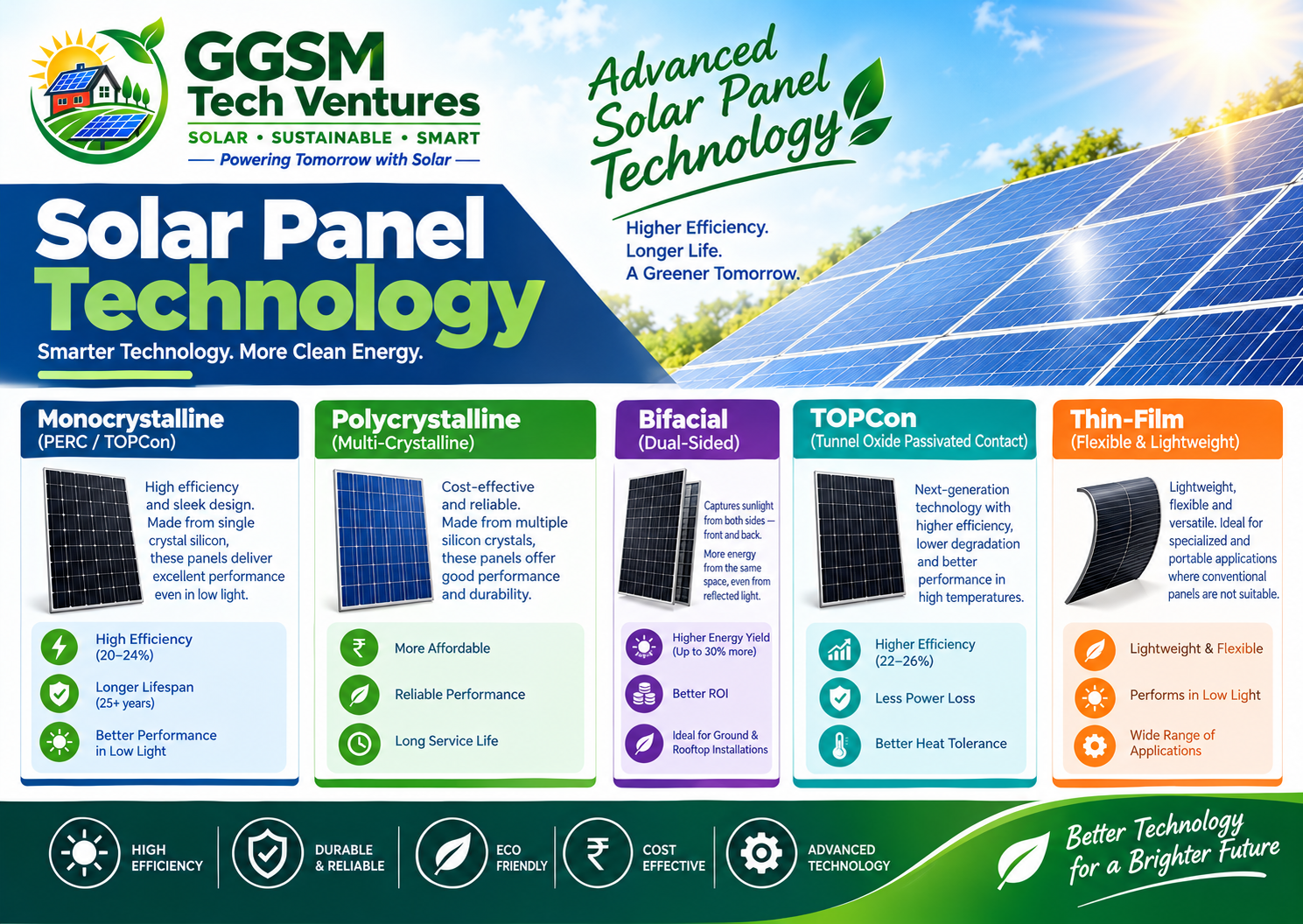
Monocrystalline solar panels are manufactured using high-purity silicon and are known for their efficiency and space-saving design.
Key benefits:
Generally higher efficiency than conventional polycrystalline panels.
Suitable for rooftops with limited installation space.
Sleek appearance for residential and commercial buildings.
Available in several modern high-efficiency cell designs.
These panels are often a good option when generating more power from a limited roof area is a priority.
2. Polycrystalline Solar Panels
Polycrystalline solar panels are made from multiple silicon crystal fragments. They were widely used in earlier solar installations and can still be found in some markets.
Key features:
Blue, multi-crystal appearance.
Historically offered a lower upfront cost in many applications.
Typically lower efficiency than modern monocrystalline options.
Their availability and price competitiveness vary, so buyers should compare current products rather than relying on panel type alone.
3. TOPCon Solar Panel Technology
TOPCon stands for Tunnel Oxide Passivated Contact. This advanced solar cell technology improves the management of electrical losses within the cell, helping increase efficiency.
Benefits of TOPCon panels:
High-efficiency options for residential and commercial projects.
Improved cell passivation that helps reduce recombination losses.
Potential for strong energy generation per square metre.
Available in modern bifacial panel designs.
TOPCon panels can be worth considering when planning a new rooftop solar system. Actual output depends on the specific module, installation conditions, and system design.
4. Bifacial Solar Panels
Bifacial solar panels can generate electricity from both their front and rear surfaces. The rear side captures reflected light from suitable surrounding surfaces.
Key benefits:
Potential for additional energy generation.
Useful for suitable elevated, ground-mounted, and commercial installations.
Can be combined with modern cell technologies such as TOPCon.
May improve project performance when the mounting structure and ground surface are designed appropriately.
The extra generation is not guaranteed. It depends on factors such as rear-side exposure, mounting height, surface reflectivity, shading, and installation design.
5. Thin-Film Solar Panels
Thin-film solar panels use thin layers of photovoltaic materials deposited onto a supporting surface. Some types are lightweight or flexible, making them useful for selected applications.
Key features:
Can be suitable for specialised installations.
Some designs offer flexibility or lower weight.
Efficiency, durability, and space requirements vary by technology.
Thin-film panels are less common than crystalline silicon modules in many standard rooftop installations, so their suitability should be assessed for each project.
How Does Solar Panel Technology Work?
Solar panels generate electricity through the photovoltaic effect. The process generally follows these steps:
Sunlight reaches the panels: Photovoltaic cells absorb light energy.
Electricity is generated: The cells produce direct current (DC) electricity.
The inverter converts power: An inverter converts DC electricity into alternating current (AC) for compatible appliances and electrical systems.
The electricity is used: Solar power supplies connected loads, subject to the system configuration and available generation.
Excess energy or storage is managed: Depending on the system, surplus electricity may be exported to the grid or stored in batteries.
Grid export, net metering, and backup power depend on the installed equipment, utility rules, and applicable regulations.
Factors That Affect Solar Panel Efficiency
Choosing a high-efficiency panel is important, but it is only one part of achieving good system performance.
Panel Efficiency
Efficiency indicates how much of the available sunlight a panel converts into electricity under specified test conditions. Higher efficiency can be especially useful when roof space is limited.
Temperature
Solar panels are tested under standard conditions, but real-world temperatures vary. Panel output can decrease as cell temperature rises, depending on the module’s temperature coefficient.
Shading
Shadows from trees, buildings, water tanks, or other obstructions can reduce energy generation. Proper site assessment and system design help minimise these losses.
Orientation and Tilt
Panel direction and tilt influence the amount of sunlight received throughout the day and year. The best arrangement depends on the location, roof structure, and project requirements.
Quality and Installation
Module specifications, inverter compatibility, mounting quality, wiring, electrical protection, and commissioning all contribute to system performance.
Cleaning and Maintenance
Dust, dirt, and bird droppings can reduce output. Appropriate inspection and cleaning help maintain performance, particularly in dusty environments.
How to Choose the Right Solar Panels for Your Property
Before purchasing solar panels, consider these important points:
Energy requirements: Review your electricity consumption and typical daytime usage.
Available roof space: Check the usable area, shading, orientation, and structural suitability.
Panel efficiency: Compare efficiency alongside rated power and physical dimensions.
Product warranty: Review the product warranty and performance warranty separately.
Manufacturer information: Check technical datasheets, certifications, and product availability.
Budget: Compare the total installed system cost, not just the price of individual panels.
Future requirements: Consider whether you may need battery storage, backup power, or additional capacity later.
Professional system design: Ensure the panels, inverter, mounting structure, and electrical protection are compatible.
The most expensive panel is not necessarily the best choice for every project. A properly designed system that matches your consumption and site conditions can be more valuable than choosing a module based on efficiency alone.
Why Modern Solar Panel Technology Matters in Uttar Pradesh
Homes and businesses across Uttar Pradesh can consider rooftop solar to make use of available sunlight and reduce their reliance on grid electricity. The benefits of a specific installation depend on the property’s energy usage, roof conditions, local utility requirements, and project economics.
For properties in Lucknow and surrounding areas, a professional assessment can help determine suitable system capacity, panel technology, inverter selection, and installation layout.
Before proceeding, check the current eligibility requirements and applicable rules for any available rooftop solar subsidy or net-metering arrangement. These may change over time and depend on the type of consumer and installation.
Why Choose GGSM Tech Ventures?
GGSM Tech Ventures provides solar solutions for residential, commercial, and industrial requirements across Uttar Pradesh.
Our solar services can help customers plan and evaluate:
Rooftop solar installation solutions.
Modern solar panel options, including suitable bifacial TOPCon modules.
Solar inverter and system configuration.
Net-metering and subsidy guidance, subject to applicable rules.
Solar monitoring and performance assessment.
Solar maintenance and Annual Maintenance Contract (AMC) services.
We focus on matching solar technology to the property’s requirements, available space, and energy goals.
Frequently Asked Questions
1. Which solar panel technology is best?
Monocrystalline panels, including modern TOPCon modules, are popular options for many new installations. The best choice depends on efficiency, available space, budget, product quality, and project requirements.
2. What is TOPCon solar panel technology?
TOPCon is an advanced silicon solar cell technology that uses a tunnel oxide passivated contact to improve cell performance and reduce electrical losses.
3. What are bifacial solar panels?
Bifacial panels can generate electricity from both sides. Their additional output depends on rear-side sunlight, installation height, surrounding surfaces, and shading.
4. Do solar panels work on cloudy days?
Yes. Solar panels can generate electricity in cloudy conditions, but output is generally lower than under strong direct sunlight.
5. How long do solar panels last?
Many quality solar modules are designed to operate for 25 years or longer. Actual service life and performance depend on the product, environment, installation, and maintenance. Always check the manufacturer’s warranty terms.
6. Are high-efficiency solar panels worth the cost?
They can be particularly valuable where roof space is limited. Compare the additional cost with expected energy generation and the overall project economics before deciding.
7. Can solar panels provide electricity during a power cut?
A standard grid-connected system usually shuts down during a grid outage for safety. Backup power generally requires a suitably designed hybrid or off-grid system with compatible equipment and, where needed, batteries.
Conclusion
Solar panel technology continues to improve through advances in cell design, efficiency, and module construction. Monocrystalline, TOPCon, and bifacial panels each offer different advantages, but the right choice depends on the property’s energy needs, available space, budget, and installation conditions.
Planning a solar installation in Lucknow or elsewhere in Uttar Pradesh? Contact GGSM Tech Ventures to discuss your energy requirements and explore a suitable solar solution for your home or business.