On-Grid vs Off-Grid vs Hybrid Solar Systems
Solar energy is becoming a popular choice for homes, businesses, and industries looking to generate renewable electricity and manage their energy costs. However, before installing solar panels, it is important to understand the three main types of solar power systems: on-grid, off-grid, and hybrid solar systems.
Each system has different features, costs, and applications. Choosing the right option depends on electricity requirements, power-cut frequency, battery needs, budget, and local electricity regulations.
What Is an On-Grid Solar System?
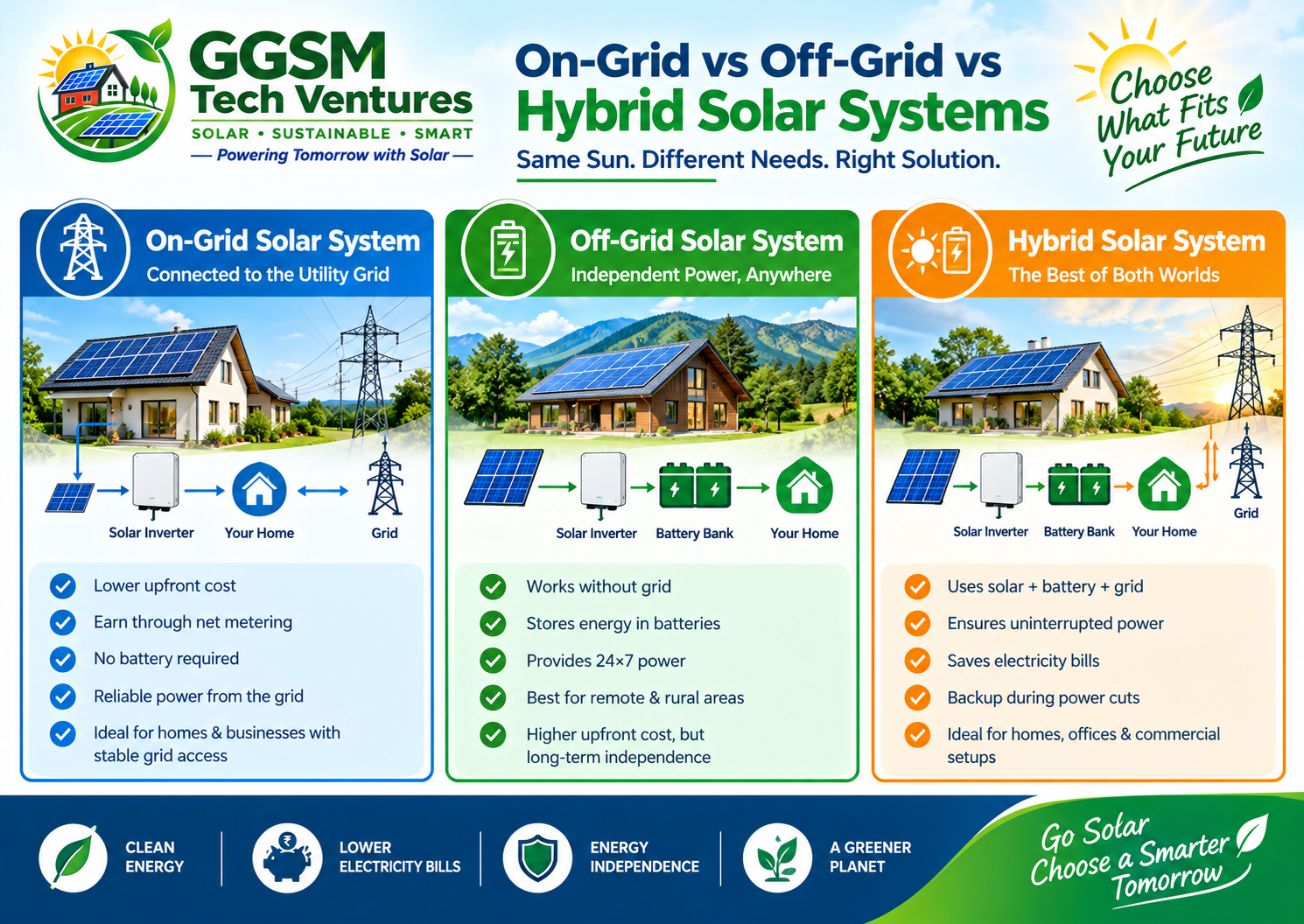
An on-grid solar system is connected to the local electricity grid. It uses solar panels to generate electricity and an inverter to convert it into usable AC power.
Solar electricity can be used by the property, while additional electricity may be imported from the grid when solar generation is insufficient. Eligible systems may also export surplus electricity under applicable net-metering arrangements.
Benefits of On-Grid Solar Systems
Helps reduce electricity bills.
Usually does not require batteries.
Can be suitable for homes and commercial buildings with reliable grid access.
May allow surplus electricity export where permitted.
Generally has lower initial costs than comparable battery-based systems.
Limitations of On-Grid Solar Systems
A standard grid-connected solar system usually shuts down during a grid outage for safety reasons. Therefore, it generally cannot supply electricity during a power cut unless specifically designed with compatible backup equipment.
Who Should Choose an On-Grid System?
On-grid solar can be a suitable choice for homes, offices, shops, and businesses that have reliable grid access and primarily want to reduce electricity costs.
What Is an Off-Grid Solar System?
An off-grid solar system operates independently of the electricity grid. It typically includes solar panels, an inverter, and battery storage to supply electricity when sunlight is unavailable.
Depending on the design, a backup generator may also be used.
Benefits of Off-Grid Solar Systems
Can operate without a grid connection.
Battery storage can provide electricity after sunset.
Can be useful in remote areas with limited grid access.
Provides greater energy independence.
Can be designed around essential electrical loads.
Limitations of Off-Grid Solar Systems
Batteries increase the initial investment.
Battery replacement may be required during the system’s lifetime.
System sizing requires careful planning.
Extended cloudy periods can reduce available energy.
Electricity use may need to be managed when stored energy is limited.
Who Should Choose an Off-Grid System?
Off-grid solar may suit remote homes, farms, rural properties, and locations where grid electricity is unavailable or unreliable.
What Is a Hybrid Solar System?
A hybrid solar system combines solar panels with battery storage and a grid connection. Depending on the equipment and configuration, it can use solar electricity, store excess energy in batteries, and draw power from the grid when needed.
Some hybrid systems can provide backup power during a grid outage, provided the inverter supports backup operation and the system is configured appropriately.
Benefits of Hybrid Solar Systems
Combines grid access with battery storage.
Can provide backup power for selected loads.
Allows stored solar energy to be used later.
Can help manage electricity consumption.
Offers flexibility for properties with backup power requirements.
Limitations of Hybrid Solar Systems
Usually costs more than a comparable system without batteries.
Requires battery installation and maintenance.
Battery capacity limits how much backup electricity is available.
Backup duration depends on battery capacity and connected loads.
Export and charging settings depend on system configuration and local regulations.
Who Should Choose a Hybrid System?
Hybrid solar can be suitable for homes and businesses that want to reduce grid electricity use while also maintaining backup power for selected appliances or equipment during outages.
On-Grid vs Off-Grid vs Hybrid Solar Systems
| Feature | On-Grid | Off-Grid | Hybrid |
|---|---|---|---|
| Grid connection | Yes | No | Yes |
| Battery storage | Usually not required | Generally required | Optional or included |
| Backup during outages | Usually no | Yes, if energy is available | Yes, if configured |
| Initial cost | Generally lower | Depends on battery and system size | Generally higher with batteries |
| Net metering | May be available | Generally not applicable | Depends on configuration and regulations |
| Best suited for | Bill reduction | Independent power supply | Bill reduction plus backup |
Which Solar System Is Best for Your Home?
The best solar system depends on your electricity usage, local power supply, budget, and backup requirements.
An on-grid system may be suitable if your main goal is to reduce electricity bills and you have reliable grid access.
An off-grid system may be appropriate if your property has no reliable grid connection and you need an independent electricity supply.
A hybrid system may be a better option if you want to use solar energy, store electricity in batteries, and maintain backup power during outages.
Before making a decision, assess your monthly electricity bills, essential loads, roof space, expected solar generation, and battery requirements.
Which Solar System Is Best for Businesses?
Commercial and industrial properties often have higher electricity consumption and different operating requirements.
On-grid solar: Can be suitable for businesses that use substantial electricity during daylight hours.
Off-grid solar: Can be considered for remote facilities without reliable grid access.
Hybrid solar: May suit businesses that need selected equipment to continue operating during grid outages.
The right system should be selected after evaluating the property’s energy consumption, operating schedule, critical loads, and financial objectives.
Factors to Consider Before Installing Solar
Before choosing a solar system, consider:
Monthly electricity consumption.
Frequency and duration of power cuts.
Required backup duration.
Available rooftop or ground space.
Battery capacity requirements.
Initial installation budget.
Inverter and equipment specifications.
Applicable net-metering regulations.
Maintenance requirements.
Future electricity needs.
A professional site assessment can help determine the appropriate system size and configuration.
Solar Solutions by GGSM Tech Ventures
GGSM Tech Ventures provides solar solutions for residential, commercial, and industrial projects.
Our services include:
Residential Solar Solutions
Commercial & Industrial Solar Solutions
On-Grid Solar Systems
Off-Grid Solar Systems
Hybrid Solar Solutions
Solar System Design & Planning
Installation & Commissioning
Solar Monitoring
Net-Metering Assistance
Solar Maintenance & AMC
We help customers explore suitable solar configurations according to their electricity requirements, site conditions, and project objectives.
Conclusion
On-grid, off-grid, and hybrid solar systems each offer different advantages. On-grid systems are commonly chosen for electricity bill reduction, off-grid systems provide independent power where grid access is limited, and hybrid systems combine grid connectivity with battery storage and potential backup capability.
The right choice depends on your power requirements, budget, location, and expectations from your solar installation.
GGSM Tech Ventures can help you explore a solar solution suited to your home, business, or industrial property.
Contact GGSM Tech Ventures to discuss your solar requirements and plan your solar installation.
Frequently Asked Questions
1. Which solar system is the most affordable?
On-grid systems are generally less expensive than comparable systems with battery storage, although actual costs depend on system size and equipment.
2. Which solar system works during a power cut?
Off-grid systems can supply power from available solar energy and batteries. Hybrid systems can also provide backup when configured with suitable equipment. Standard on-grid systems generally shut down during grid outages.
3. Does an on-grid solar system need batteries?
Usually, no. An on-grid system can operate without batteries when the objective is to use solar electricity and interact with the grid.
4. Is a hybrid solar system suitable for homes?
Yes. Hybrid systems can be suitable for homes that want solar electricity and backup power for selected loads.
5. Can an off-grid system run at night?
Yes, if sufficient energy has been stored in the batteries or another backup power source is available.
6. Can hybrid solar systems use net metering?
Some hybrid configurations may qualify, subject to system design, applicable regulations, and approval from the relevant electricity distribution authority.
7. Which solar system is best for commercial buildings?
The best option depends on electricity consumption, grid reliability, backup requirements, available space, and project budget.
8. Does GGSM Tech Ventures provide different types of solar systems?
GGSM Tech Ventures offers solar planning and solutions for residential, commercial, and industrial requirements. The suitable system configuration should be confirmed according to the project’s needs.