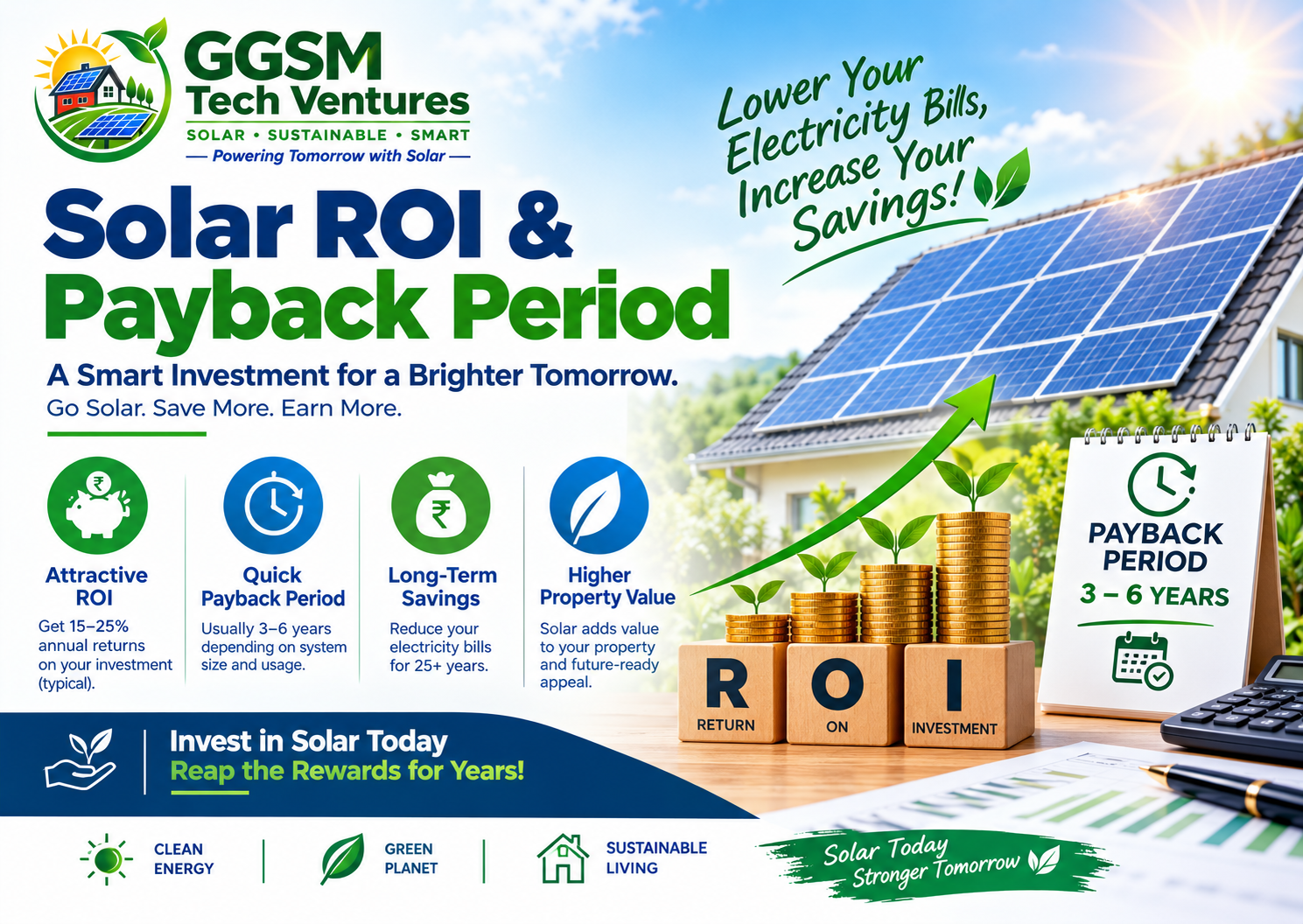
Solar ROI & Payback Period
Installing a solar power system is a long-term energy investment for homes, businesses, and industrial facilities. Before installing solar panels, many customers want to understand how much they may save on electricity costs and how long it could take for the investment to recover.
Two important terms used to evaluate a solar investment are ROI (Return on Investment) and Payback Period.
The actual ROI and payback period depend on factors such as system cost, solar generation, electricity consumption, electricity tariff, maintenance expenses, applicable subsidies, and system performance.
What Is Solar ROI?
Solar ROI refers to the financial return generated by a solar investment over a specific period.
In simple terms, it compares the financial benefits received from the solar system with the cost of installing and operating the system.
A solar project’s financial return can come primarily from electricity cost savings and, where applicable, other benefits associated with the project’s electricity arrangement.
What Is Solar Payback Period?
The solar payback period is the estimated time required for the cumulative financial benefits from a solar system to equal its initial investment cost.
For example, if a solar project costs ₹5 lakh and provides average annual financial benefits of ₹1 lakh, the simple payback period would be approximately 5 years.
Actual results can differ because solar generation and electricity costs can change over time.
Factors That Affect Solar ROI
Several factors influence the financial return of a solar project.
1. Solar System Cost
The initial cost may include:
Solar panels
Inverter
Mounting structure
Electrical equipment
Installation
Cabling
Protection equipment
Monitoring system
The total cost varies according to system size, equipment specifications, installation conditions, and project requirements.
2. Electricity Consumption
A property with higher electricity consumption may be able to utilize more of the electricity generated by its solar system.
Understanding current and expected electricity consumption is therefore important when designing the system.
3. Electricity Tariff
Electricity tariffs affect the value of the electricity generated by the solar system.
If the applicable electricity tariff changes, the potential financial benefits of solar may also change.
4. Solar Energy Generation
Solar generation depends on:
Solar irradiation
System capacity
Panel orientation
Tilt angle
Shading
Weather
Equipment performance
System maintenance
A properly designed system can help maximize the use of available solar resources.
5. Solar Subsidy
Eligible customers may receive financial assistance under applicable government solar schemes.
If a subsidy applies to a project, it can reduce the customer’s effective investment cost and may affect the estimated payback period.
Subsidy availability and eligibility depend on the current scheme and applicable regulations.
6. Net Metering
Eligible grid-connected solar systems may use applicable net-metering arrangements.
Where permitted, surplus electricity may be exported to the grid according to the applicable rules. The financial impact depends on the relevant electricity regulations and billing arrangement.
How Is Solar Payback Calculated?
A simple payback estimate can be calculated by comparing the initial investment with the estimated annual financial benefit.
Simple Payback Period = Initial Solar Investment ÷ Annual Financial Benefit
For example:
Solar investment: ₹4,00,000
Estimated annual electricity savings: ₹80,000
Estimated simple payback:
₹4,00,000 ÷ ₹80,000 = 5 years
This is only an example. Actual project economics should be calculated using the property’s electricity consumption, system generation, tariff, costs, applicable subsidy, and other relevant factors.
Solar ROI for Residential Properties
For homes, solar ROI depends on electricity consumption, system capacity, rooftop conditions, electricity tariff, and applicable subsidy or grid arrangements.
A residential solar assessment may consider:
Monthly electricity bills
Annual electricity consumption
Available roof area
Required solar capacity
Expected annual generation
System installation cost
Applicable subsidy
Maintenance expenses
Solar ROI for Commercial & Industrial Projects
Commercial and industrial solar projects can have different financial calculations because electricity consumption and tariffs may be significantly different from residential properties.
Important factors include:
Annual electricity consumption
Daytime electricity usage
Electricity tariff
Solar system capacity
Available installation area
System cost
Expected generation
Maintenance costs
Applicable grid arrangements
A detailed project analysis can provide a more useful estimate than using a general payback period.
Why Solar Performance Monitoring Matters
Solar monitoring helps track actual electricity generation after installation.
Monitoring can provide information such as:
Daily generation
Monthly generation
Total generation
Inverter status
System alerts
Performance history
Actual generation data can be compared with expected generation to understand system performance.
How Maintenance Can Support Solar Performance
Regular maintenance is important for long-term system operation.
Maintenance may include:
Solar panel cleaning
Panel inspection
Inverter inspection
Electrical connection checks
Cable inspection
Earthing checks
Performance monitoring
Keeping the system properly maintained can help support consistent performance over its operating life.
Solar ROI Calculation by GGSM Tech Ventures
GGSM Tech Ventures can help customers understand the key factors involved in planning a solar project.
Our solar services include:
Solar Site Assessment
Energy Consumption Analysis
Solar System Design
Solar Capacity Planning
Installation & Commissioning
Solar Monitoring
Net-Metering Assistance
Solar Maintenance & AMC
We can help customers evaluate a solar project based on their property, electricity requirements, available space, and project objectives.
Important Factors Before Investing in Solar
Before calculating the expected ROI, customers should consider:
Current electricity consumption
Electricity tariff
Solar system capacity
Installation cost
Expected annual generation
Applicable subsidy
Net-metering rules
Maintenance requirements
Available rooftop or ground space
Expected system operating period
Using project-specific data provides a more meaningful financial estimate.
Conclusion
Solar ROI and payback period are useful indicators when evaluating a solar investment. However, there is no single payback period that applies to every property.
The actual financial outcome depends on system cost, electricity consumption, solar generation, tariffs, subsidies, maintenance, and applicable electricity regulations.
GGSM Tech Ventures provides solar planning, system design, installation, monitoring, net-metering assistance, and maintenance solutions for residential, commercial, and industrial projects.
Contact GGSM Tech Ventures to discuss your solar requirements and understand the potential economics of a solar system for your property.
Frequently Asked Questions
What is solar ROI?
Solar ROI represents the financial return generated by a solar investment compared with its associated cost.
What is the solar payback period?
It is the estimated time required for the cumulative financial benefits of a solar system to equal its initial investment.
How long does solar take to pay back?
The payback period varies by project. It depends on system cost, electricity savings, generation, tariffs, subsidy, and other factors.
Does solar subsidy affect payback?
If an eligible subsidy reduces the effective project cost, it can affect the estimated payback period.
Does electricity tariff affect solar ROI?
Yes. Electricity tariffs influence the financial value of electricity generated by the solar system.
Can GGSM Tech Ventures help calculate solar ROI?
GGSM Tech Ventures can help assess the key project factors required to estimate solar economics based on your property’s requirements.